In most Bihar homes, the festive season ends the same way. The ghat empties, the soop goes back on the shelf, and a steel dabba of thekua sits in the kitchen for the next two weeks. One with morning chai. Two when a neighbour drops in. Another at night, because it’s prasad and nobody says no to prasad.
Then someone steps on the weighing scale.
If you’ve wondered what all that adds up to, this guide gives you a straight answer on thekua calories per piece, worked out from a standard home recipe with the maths shown. You’ll also see how thekua compares with other Diwali and Chhath sweets, why the scale jumps more than it should after festivals, and a simple 14-day plan to settle back into routine. No detox drinks, no starving, and no guilt about prasad.
How many calories are in one thekua?
A medium homemade thekua of about 30 grams has roughly 125–150 calories, about the same as one gulab jamun. Deep-fried thekua works out at around 420–500 calories per 100 grams, so the real number depends mostly on size:
| Thekua size | Approx. weight | Calories (approx.) |
|---|---|---|
| Small | 20 g | 85–100 kcal |
| Medium (most home thekua) | 30 g | 125–150 kcal |
| Large (big saancha) | 45 g | 190–225 kcal |
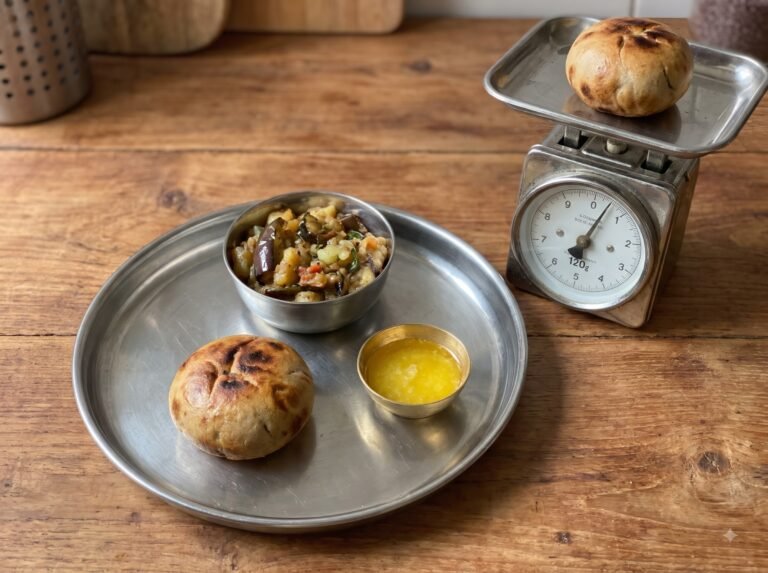
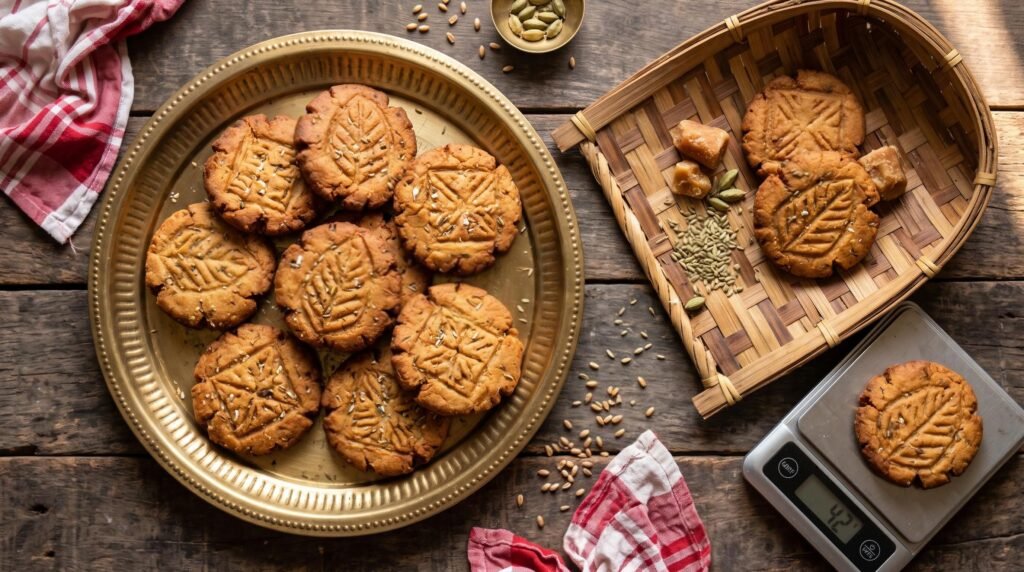
The easiest way to know which row is yours: put one thekua on a kitchen scale. It takes ten seconds and settles the question for the whole batch.
Is one thekua really equal to one gulab jamun?
For a medium piece, yes, roughly. Tarla Dalal lists a 25-gram gulab jamun at about 125 calories, and its khoya version at about 175. FatSecret puts one piece at 145. A medium thekua at 125–150 calories sits right in that range.
Size changes the picture, though. A large thekua from a big saancha is closer to one and a half gulab jamuns, and a small one is closer to a mini gulab jamun.
The calories come from different places. In gulab jamun they come mainly from khoya, frying and sugar syrup. In thekua they come from atta, jaggery and the oil it soaks up while frying. Thekua’s whole wheat gives it a little fibre, but in calorie terms the two sweets are close cousins. That’s useful to know, because most people would never eat five gulab jamuns in a day without noticing, yet five thekua with chai and visitors slip by easily.
Why the thekua calories online don’t match
Search for thekua calories and you’ll see anything from 80 to about 200 calories per piece. One popular calorie database lists 80 kcal but doesn’t say how big the piece is. A recipe card lists 167 kcal for a 45-gram thekua. A baked version comes in at about 100 kcal, while one thekua brand puts its roughly 40-gram piece at 160–170 kcal.
They’re not all wrong. Three things change the number a lot:
- Size. A 45-gram thekua has more than twice the calories of a 20-gram one.
- Oil absorbed during frying. This is the biggest unknown, and it varies with dough thickness, frying temperature and time.
- Extras in the dough. More ghee for moyan, more coconut or dry fruits, and the count goes up.
How we worked it out

We used a widely followed home recipe as the base: 300 g whole wheat atta, 150 g jaggery, 50 g grated coconut, 2 tablespoons of ghee for moyan, and oil for deep frying. Each ingredient was multiplied by its standard energy value per 100 grams.
| Ingredient | Amount | Approx. calories |
|---|---|---|
| Whole wheat atta | 300 g | ~1,020 |
| Jaggery (gur) | 150 g | ~570 |
| Grated dry coconut | 50 g | ~330 |
| Ghee (moyan) | 2 tbsp (~26 g) | ~235 |
| Oil absorbed while frying (assumed) | 40–70 g | ~360–630 |
| Whole batch | ~560–600 g fried | ~2,500–2,800 |
Divide the batch calories by the fried weight and you get roughly 420–500 kcal per 100 g. Treat this as a careful estimate, not a lab value. The oil figure is an assumption, and it’s the main reason for the range.
One more number worth knowing: in this recipe, a 30-gram thekua carries about 7–8 grams of jaggery. Jaggery is less refined than white sugar, but it is still mostly sugar.
Thekua calories vs other festive sweets
Here’s how thekua calories compare with the sweets and snacks that move around between Dhanteras and Chhath. Piece sizes vary a lot between halwais and homes, so read these as ballpark figures.
| Sweet or snack | Typical piece | Calories (approx.) | Where the figure comes from |
|---|---|---|---|
| Thekua (homemade, fried) | 30 g | 125–150 kcal | Our estimate above |
| Kaju katli | 1 piece, 10–30 g | 40–120 kcal | Tarla Dalal lists a small piece at 41 kcal; a hospital nutritionist quoted by Business Standard puts 20–30 g pieces at 80–120 kcal |
| Gulab jamun | 25 g | 125–175 kcal | Tarla Dalal (two recipes); FatSecret lists 145 kcal per piece |
| Laddoo | 45–50 g | 180–210 kcal | Hospital nutritionist, quoted by Business Standard |
| Aloo samosa | 30 g (small, street size) | ~130 kcal | Clearcals |

We couldn’t find a reliable published figure for Bihar’s khaja, so it’s left out rather than guessed.
So thekua isn’t lighter than mithai; it sits in the same range as most festive sweets. Three thekua with a cup of sweet chai come close to a light meal.
Is thekua healthy?
Thekua has real advantages over many shop-bought sweets. It’s usually made with whole wheat instead of maida, sweetened with jaggery, made at home, and has no preservatives. That’s a fair reason to prefer it over a box of mithai.
But “healthier ingredients” isn’t the same as “low calorie.” Thekua is deep fried and sweet. Some articles say ghee in thekua is good for the heart because of omega-3 fats. Ghee is mostly saturated fat; it isn’t an omega-3 food.
The real issue isn’t one thekua. It’s the quiet repetition over two weeks. Three medium thekua a day for 14 days comes to about 42 pieces, or roughly 5,000–6,300 extra thekua calories on top of normal meals. That’s where the festive kilo actually comes from.
Why the scale jumps after festivals (and why most of it isn’t fat)
It’s common to see the scale go up by one or two kilos in the week after Diwali or Chhath. Most of that is not fat.
A kilo of body fat stores roughly 7,700 calories. To gain two kilos of actual fat in a week, you’d need to eat about 15,000 calories more than you burn, which is far more than even a generous festive week. The sudden jump is mostly:
- Water held with extra carbohydrates. Sweets, puris and rice refill your muscles’ glycogen stores, and glycogen is stored with water.
- Salt. Namkeen, pakoras and pickles make the body hold more water for a few days.
- Food still in your gut. Bigger meals simply weigh more on the way through.
- Missed routine. Fewer walks, late nights and irregular meals add up.
The festive extras we calculated above (about 5,000–6,300 calories from thekua alone) would be closer to 0.7–0.8 kg of real fat, and only if every bit came on top of your normal eating.
Research backs up this “small but sticky” pattern. A well-known US study in the New England Journal of Medicine weighed 195 adults before and after the winter holiday season. The average gain was just 0.37 kg, much less than people assume. But some people gained much more: 14% put on over 2.3 kg. The gain was also not lost in the following months, and it accounted for roughly half of the participants’ weight gain for the whole year.
That study was done in the United States, not India, so treat it as a pattern rather than an exact prediction. The message is still useful: don’t panic about the scale after Chhath, but don’t ignore the small gain either. Left alone, it tends to stay.
The 14-day reset after Chhath
This plan starts the day after Usha Arghya (17 November 2026) and runs to the end of the month. It uses ordinary Bihar home food and asks for nothing extreme.
Days 1–3: back to normal, not to a crash diet
- Go back to regular meal times. Don’t skip meals to “make up” for the festival; it usually leads to bigger hunger in the evening.
- Cut down on namkeen, pickles and fried snacks for a few days. ICMR-NIN guidance is to keep salt under 5 grams a day, and less salt helps the extra water settle.
- Drink water normally. There’s no need for jeera water, lemon-honey water or any “detox” drink.
- Don’t weigh yourself every morning yet. Day-to-day readings will be noisy.
Days 4–10: build every meal around protein
Use a simple plate rule: half the plate vegetables, a quarter dal, chana, paneer, curd or soya, and a quarter rice or roti. Protein keeps you fuller, which makes it easier to eat a little less without fighting hunger.

Here’s what a normal day can look like:
| Meal | What to eat |
|---|---|
| Morning chai | Tea with less sugar, plus one thekua if you like (yes, really) and a small handful of roasted chana |
| Breakfast | Chura-dahi, a sattu paratha with curd, moong dal chilla, or poha with peanuts |
| Lunch | One katori rice or two roti, dal, a sabzi, curd and salad |
| Evening | Salted sattu sharbat, roasted makhana or chana chaat |
| Dinner | Two roti with paneer, chana or soya sabzi, and salad |
The thekua stays in the plan on purpose. One planned piece with chai is easy to fit in. Five unplanned pieces through the day is what adds up.
Days 11–14: check the trend
Weigh yourself on three or four mornings this week, at the same time and after the toilet, and look at the average. Compare it with your weight before Dhanteras if you know it.
- Back to your usual weight? The jump was mostly water. Carry on with normal eating.
- Still 1 kg or more above? Keep the plate rule and trim portions a little, roughly 300–500 calories less a day. In practice that’s one less roti at dinner and skipping the second sweet. Give it another two to three weeks.
Move a little more, every day
- Walk 10–15 minutes after lunch and dinner. November evenings in Bihar are pleasant for it, and short walks after meals are easier to keep up than one long session.
- Do two short strength sessions a week. Squats, wall or incline push-ups and lunges for 20 minutes at home are enough to start. These full-body home workouts give you a ready routine.
- Sleep seven hours or more. Late festival nights push hunger up the next day.
What to do with the leftover thekua
There’s often a big dabba left after Chhath, and throwing prasad away isn’t an option. Some simple ways to handle it:
- Decide a daily number, one or two, and take them out of the dabba rather than eating from it.
- Share it. Sending prasad to neighbours, colleagues and relatives who couldn’t come is part of the festival anyway.
- Pair it with protein. A thekua with a glass of milk or some roasted chana is more filling than a thekua with another sweet.
- Keep the dabba out of sight. Food on the counter gets eaten; food in a cupboard mostly doesn’t.
A note for vratis
The 36-hour nirjala fast after Kharna is one of the toughest fasts in India, and many vratis are older family members. If you or someone at home has diabetes, high blood pressure, heart or kidney disease, takes regular medicines, or is pregnant, speak to a doctor before the vrat about medicine timing and warning signs to watch for.
After Usha Arghya, break the fast gently. Start with water and a little prasad, and leave the heavy meal for a few hours later.
Mistakes to avoid after the festive season
- Detox drinks and “fat-flushing” waters. Your liver and kidneys already do this job. These drinks don’t remove fat.
- Crash dieting. Eating very little for three days usually ends in a bigger binge on day four.
- Judging progress by one morning’s weight. Water swings can hide or exaggerate real change for days.
- Blaming prasad. Thekua isn’t the problem. Eating it without noticing, on top of everything else, is.
- Trying to “burn off” sweets with long cardio sessions. Food choices make a far bigger difference than an extra hour on the treadmill. If you want to train, these fat-burning exercises that also build muscle are a better use of your time.
Frequently asked questions
How many calories are in 1 thekua?
A medium homemade thekua of about 30 grams has roughly 125–150 calories. A small 20 g piece is around 85–100 calories, and a large 45 g piece around 190–225. Weigh one to know which thekua calories figure applies to you.
Is 1 thekua equal to 1 gulab jamun in calories?
Roughly, for a medium 30-gram thekua. Both land around 125–150 calories. A large thekua is closer to one and a half gulab jamuns.
Ek thekua mein kitni calorie hoti hai?
Ghar ke medium thekua (lagbhag 30 gram) mein qareeb 125–150 calorie hoti hai. Chhota thekua (20 gram) 85–100 calorie, aur bada thekua (45 gram) 190–225 calorie ke aas-paas hota hai. Pet ki charbi kam karni hai to hamara 1 month simple Indian diet plan bhi dekhein.
Is thekua good for weight loss?
It isn’t a weight-loss food. It’s a deep-fried sweet, even if it’s made with atta and jaggery. One or two a day can fit into a balanced diet; several a day for weeks will slowly add up.
Does baked thekua have fewer calories?
Yes. In our estimate, the frying oil accounts for roughly 15–25% of fried thekua calories, so baking saves a meaningful amount. One baked thekua recipe lists about 100 calories per piece, though piece sizes differ between recipes.
Is jaggery thekua healthier than sugar thekua?
The calories are about the same. Jaggery carries small amounts of minerals that white sugar doesn’t, but both are mostly sugar, so the portion matters more than the sweetener.
How long does it take to lose festive weight?
The water part usually settles within a few days to a week of normal eating. If real weight stays higher after two weeks, a modest calorie cut with daily walks typically brings it down over a few weeks. Results vary from person to person.
Final takeaway
Enjoy the thekua. It’s prasad, it’s made with care, and one piece with your evening chai is no problem at all. Just know the thekua calories: a medium piece is roughly 125–150, about the same as a gulab jamun. The festive kilo comes from repetition, not from any single sweet.
Give yourself 14 calm days after Chhath: regular meals, protein on every plate, a short walk after meals and a daily thekua limit you actually decide. That’s usually enough to bring the scale back to where it was.